
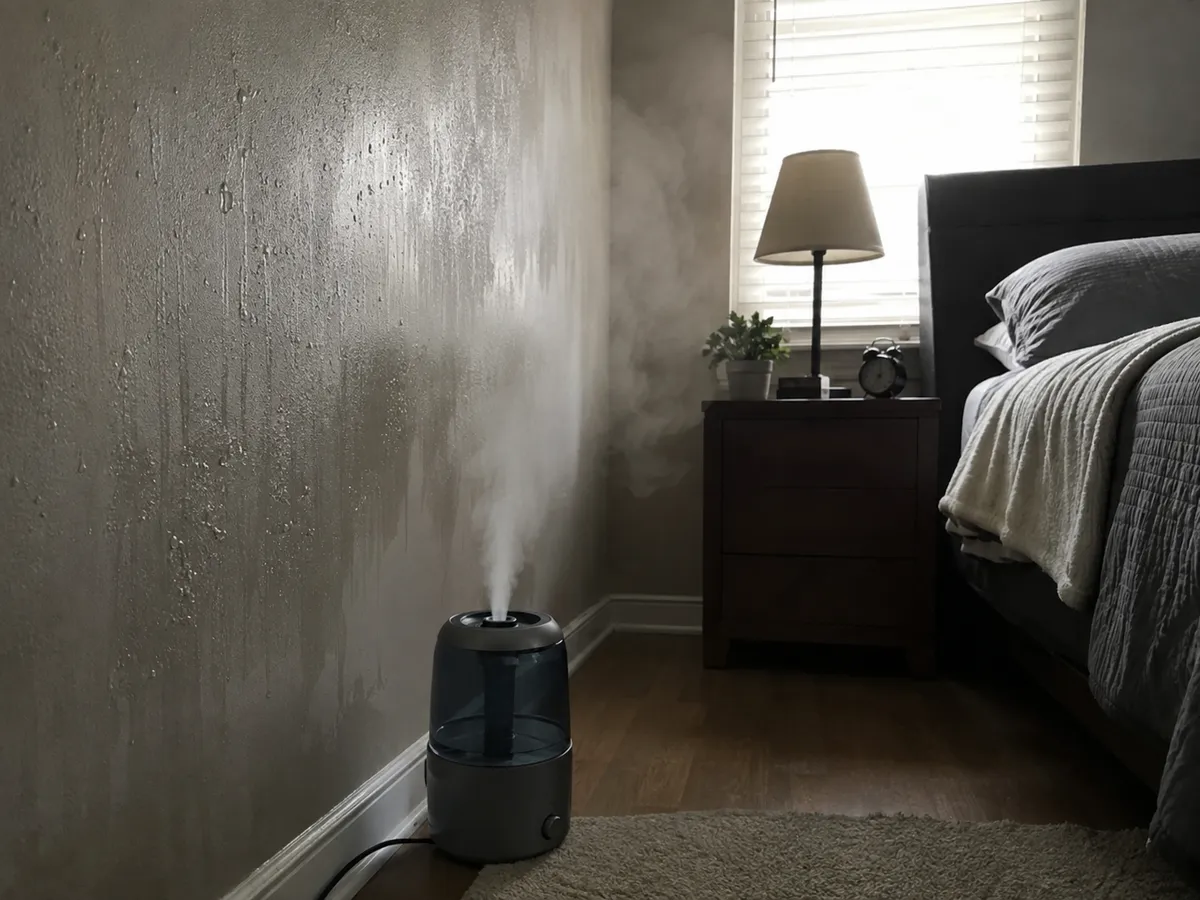
Yes. Not because humidity is bad, but because a bedroom is the single worst room in the house to add moisture to without measuring it. The door is closed. The air is still for eight hours. Furniture sits flat against exterior walls. And in a Michigan winter, the surface temperature of that exterior wall can sit below the dew point of the air you just humidified. Moisture leaves the air and lands on the wall. That is condensation, and condensation is how mold starts.
A humidifier is a useful tool. Run it against a hygrometer and a dehumidifier, and it stays useful. Run it on high with no measurement, in a closed bedroom, from November through March, and it becomes a moisture source that behaves a lot like a slow leak.
Here is how to run one correctly.
The only number that matters
The EPA recommends keeping indoor relative humidity below 60 percent, ideally between 30 and 50 percent. That range is not a comfort preference. It is a biology threshold. Below it, mold, dust mites, and bacteria have a hard time establishing. Above it, they do not.
The EPA is specific about humidifiers in Mold Course Chapter 9: humidifiers should be set to produce less than 60 percent relative humidity, because anything above that is likely to result in condensation, which leads to mold growth. It also flags humidifier filters as a place mold grows, and it tells you to watch the carpet around the unit for wetness.
So the target is simple. In a Michigan winter, hold your bedroom between 35 and 45 percent. That is comfortable for sinuses and skin, and it leaves room on the top end for the humidity spike that happens overnight when the door is shut and two people are breathing in a closed room.
Buy a hygrometer. They cost less than a tank of gas. Put one on the nightstand and a second one on the floor near the exterior wall, because the number at the nightstand and the number six feet away at the cold wall are not the same number.
Not sure if that spot on the wall behind your bed is mold?
Snap a photo and get a free AI analysis in about 60 seconds, no appointment needed.
Why bedrooms are the highest-risk room for added moisture
Kitchens and bathrooms produce far more water vapor than a humidifier ever will. The difference is that those rooms are built to get rid of it. They have exhaust fans, hard surfaces, and short occupancy. A bedroom has none of that.
- The door is closed for eight hours. Whatever the humidifier puts out has nowhere to go. Two adults sleeping add roughly a pint of water vapor to the room through respiration on top of that.
- The air is not moving. Still air stratifies. Moisture accumulates at the coldest surfaces instead of mixing back into the room.
- Furniture blocks airflow at the exact wrong place. A headboard, a dresser, or a mattress pushed against an exterior wall creates a pocket of dead air against the coldest surface in the room. That is where condensation shows up first and where nobody looks.
- Closets on exterior walls are worse. Closed door, no airflow, cold wall, and soft goods that hold moisture and feed growth.
- Nobody sees the wall until spring. By the time a homeowner pulls the bed away from the wall in April, growth has had an entire heating season to establish.
The dew point problem in a Michigan winter
This is the part most people miss. Relative humidity is not a fixed amount of water. It is a percentage of what the air can hold at a given temperature. Cold air holds less. So when warm, humidified room air touches a cold surface, the relative humidity right at that surface climbs, and if the surface is cold enough, water condenses out.
The temperature at which that happens is the dew point. Here is what the dew point looks like for a room held at 70 degrees Fahrenheit, calculated from standard psychrometric relationships:
On a 15 degree Michigan night, the interior surface of a poorly insulated exterior wall behind a dresser can easily sit in the 40s. At 50 percent bedroom humidity, that surface is below dew point all night, every night. It does not need a leak. The humidifier is the leak.
This is also why window condensation matters. Water beading on the inside of your bedroom windows is not a window problem. It is a humidity gauge telling you the room is wetter than the building envelope can handle. The window is simply the coldest surface, so it fails first. The wall behind your headboard is next.
How this plays out in Metro Detroit homes
The same humidifier behaves very differently depending on the age and style of the house, and Metro Detroit has both extremes in large numbers.
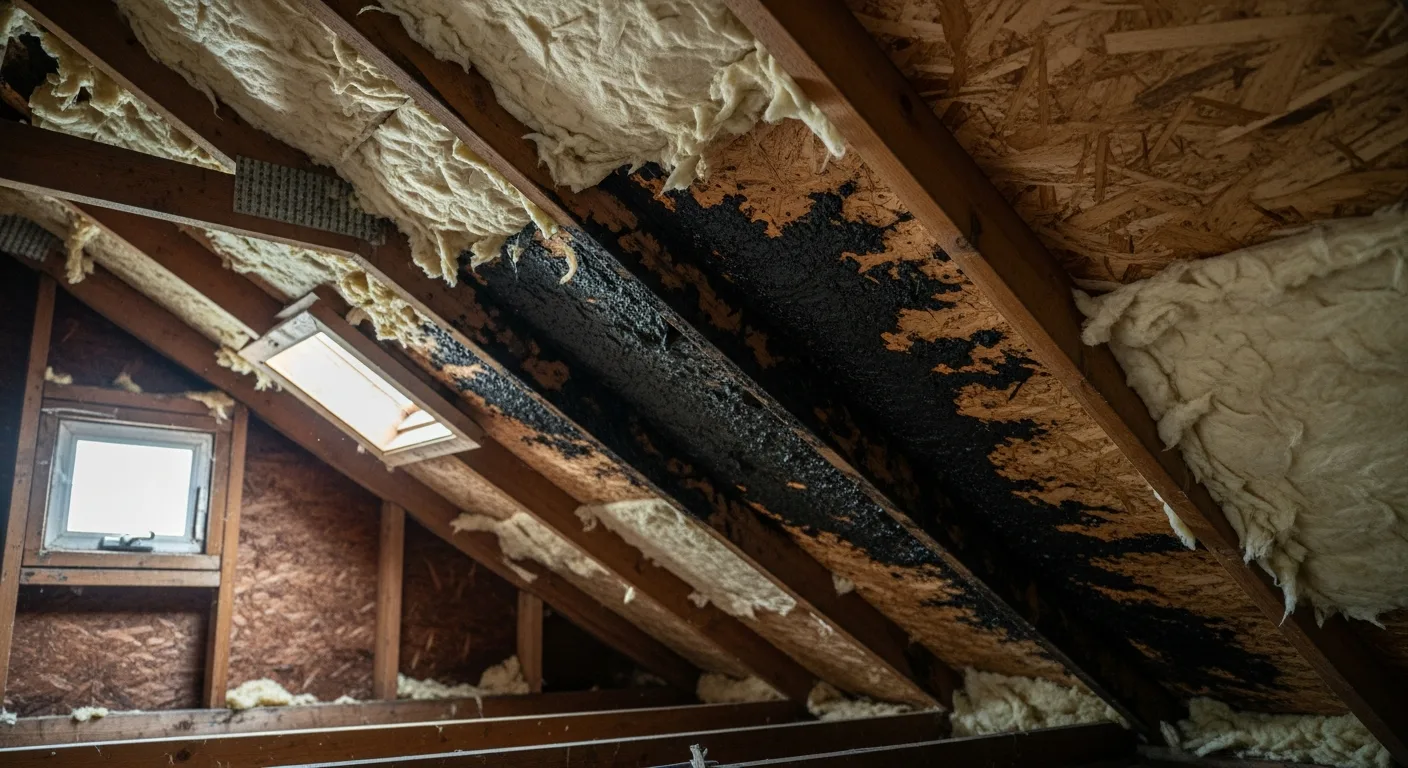
Older inner-ring suburbs like Royal Oak, Ferndale, and Berkley are dominated by pre-1960 bungalows and small colonials. Bedrooms are small, which means a humidifier saturates the room fast. Wall assemblies in that era were often built with little or no cavity insulation, and plaster over lath gives you a cold, absorbent interior surface. Upstairs bedrooms in a story-and-a-half bungalow sit under knee walls with sloped ceilings that are difficult to insulate well, so the cold surfaces are numerous and close to where people sleep. We frequently find condensation staining at the top plate and along sloped ceiling seams in these homes.
Newer suburbs farther out like West Bloomfield, Commerce Township, and Novi are the opposite geometry. Larger 1970s through 2000s colonials with vaulted primary bedrooms, walk-in closets on exterior walls, and finished lower levels. Two things stack here. First, a vaulted bedroom moves humidified air up to a ceiling plane that is frequently the coldest surface in the house. Second, many of these are lake communities, and homes near Cass Lake, Pine Lake, Walnut Lake, and Union Lake tend to carry higher ambient ground moisture that already loads the basement before anyone turns on a humidifier upstairs.
That second point matters more than it sounds. Warm, moist air rises through a house. A humidifier running in a second floor bedroom is not an isolated system. It is one input into a whole-house moisture balance that also includes the basement, the crawl space, the laundry, and the showers.
Why you need a dehumidifier in the same house
A humidifier and a dehumidifier are not opposites that cancel each other out. They are two halves of a control loop, and most Michigan homes need both across a full year.
Think of it as three jobs:
- Winter, upstairs: the humidifier adds moisture to heated air that has dried out. Target 35 to 45 percent.
- Year round, basement: the dehumidifier removes moisture that arrives through the slab, the foundation walls, and the outdoor air. Target 45 to 50 percent, and never above 55.
- Summer, whole house: the dehumidifier or the air conditioner carries the load. The humidifier goes off and gets cleaned and stored.
Running the humidifier without a dehumidifier anywhere in the house means you have an input with no output. Every home has a moisture budget. Adding to it without a way to subtract is how a comfortable bedroom turns into a wet one.
Practical setup for a typical Metro Detroit two story with a basement:
- One dehumidifier in the basement, drained to a floor drain or condensate pump so nobody has to remember to empty a bucket. A bucket that gets forgotten is its own mold source.
- Humidifiers only in the bedrooms that actually need them, sized to the room. An oversized unit in a small bedroom is the most common mistake we see.
- A hygrometer in the bedroom and a second one in the basement. Two numbers, checked weekly.
- If you have a whole-house humidifier on the furnace, find the humidistat and turn it down. Most are set far too high for a Michigan January and get set once and forgotten for years.
The weekly dry-out: how to reset the room
Even a correctly sized humidifier held at 40 percent will load soft goods and wall cavities over months of continuous use. Materials absorb moisture slowly and release it slowly. A room can read fine on a hygrometer while the drywall, carpet pad, and closet contents are steadily gaining water.
The fix is a periodic dry-out. Once a week during heating season:
- Shut the humidifier off for 24 hours. Not overnight. A full day, so the room actually returns to the house baseline.
- Open the bedroom door and the closet doors. Let the room exchange air with the rest of the house instead of sitting sealed.
- Pull furniture off exterior walls. Move the bed and the dresser out three or four inches for the day and let the wall surface breathe and dry. Then check the wall while it is exposed. This one habit catches most problems early.
- Run the bathroom exhaust fan or the furnace fan on circulate. Moving air is drying air. Continuous fan mode on the furnace mixes the house and eliminates the stagnant pockets that condensation depends on.
- On a cold, dry day, crack a window for 10 to 15 minutes. Winter air is very dry in absolute terms. A short air exchange drops indoor moisture quickly without costing much heat.
- Wipe any window condensation the same morning you see it. Water sitting on a sill soaks the paint, the wood, and eventually the drywall below it. This is one of the most common places we find growth on inspections.
- Do a full seasonal dry-down in spring. When the heat goes off for the year, shut the humidifier down, clean it, dry it completely, and store it. Do not leave water in a stored tank.
If a 24 hour dry-out causes noticeable discomfort, the answer is not more humidity. It is a lower steady setting, checked against a hygrometer, running continuously instead of a high setting running in bursts.
The humidifier itself can be the mold source
Separate from what it does to the room, the machine is a warm tank of standing water in a bedroom.
The EPA notes that ultrasonic and cool mist impeller humidifiers can disperse microorganisms and minerals from their tanks directly into indoor air, and that proper care and cleaning are what reduce that exposure. The Consumer Product Safety Commission is blunter: bacteria and fungi often grow in the tanks of portable humidifiers and can be released in the mist, and film or scum on the water surface or tank walls is the visible sign that it has already happened.
The maintenance rules that follow from that:
- Empty and refill daily. Not top off. Empty, wipe the tank dry, refill fresh. Water that sits for three days is a culture.
- Use distilled or demineralized water. Tap water leaves scale, and scale gives biofilm a surface to grow on. It also reduces the white mineral dust that ultrasonic units aerosolize.
- Descale and disinfect on the schedule in your manual. Most call for weekly. Rinse thoroughly so nothing gets aerosolized into a room you sleep in for eight hours.
- Replace the wick or filter on schedule. A wet evaporative wick left in place past its life is a growth surface with air being pushed through it.
- Never set it directly on carpet. Put it on a hard tray, at least a few feet from walls and furniture, and check the floor around it for dampness.
- Have furnace-mounted humidifiers serviced before heating season. These run water through the HVAC system, and anything growing there gets distributed to every room the ductwork serves.
Warning signs it has already gone too far
- Condensation or frost on the inside of bedroom windows on cold mornings.
- A musty smell that is strongest when you first open the bedroom door in the morning.
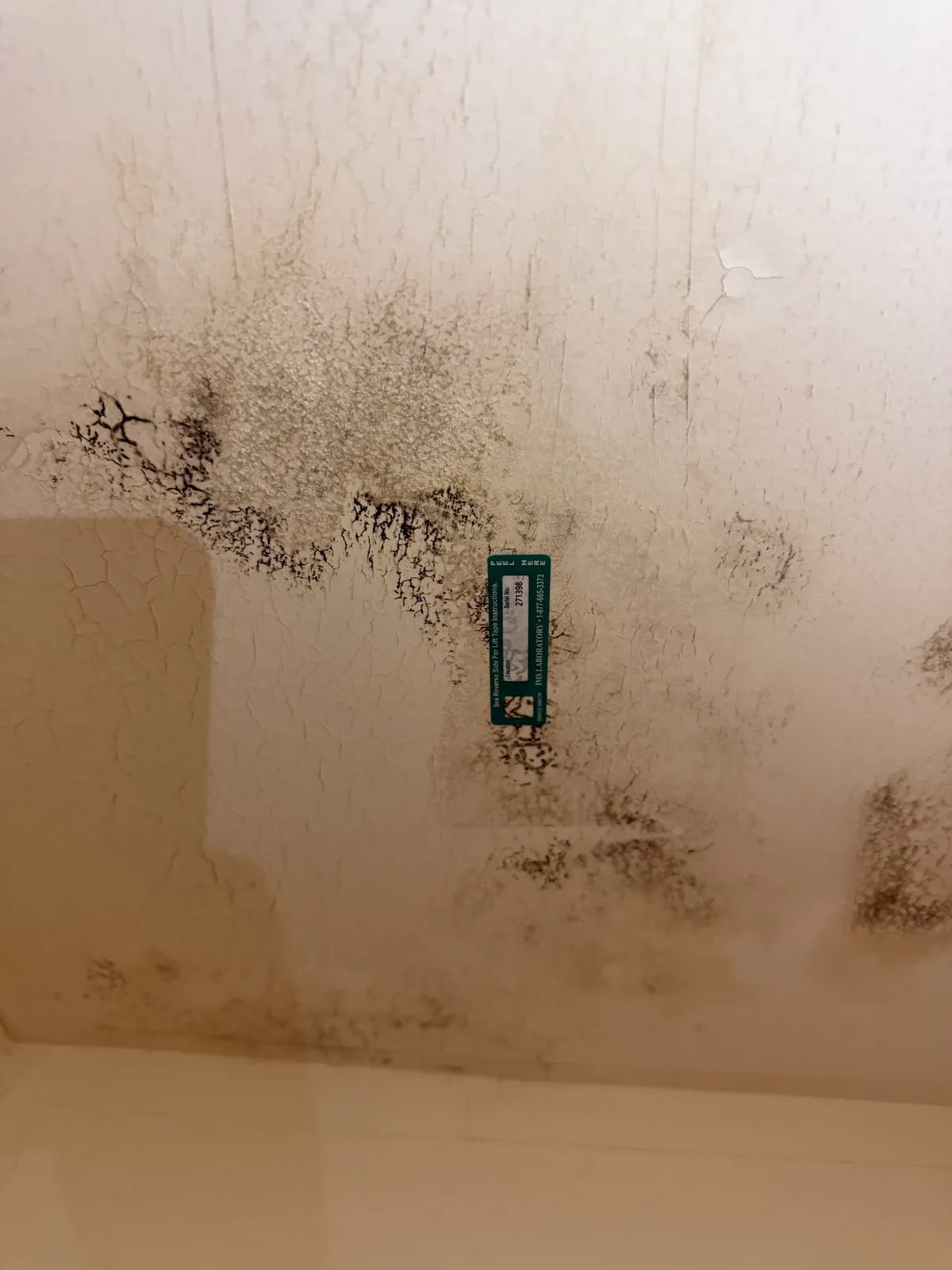
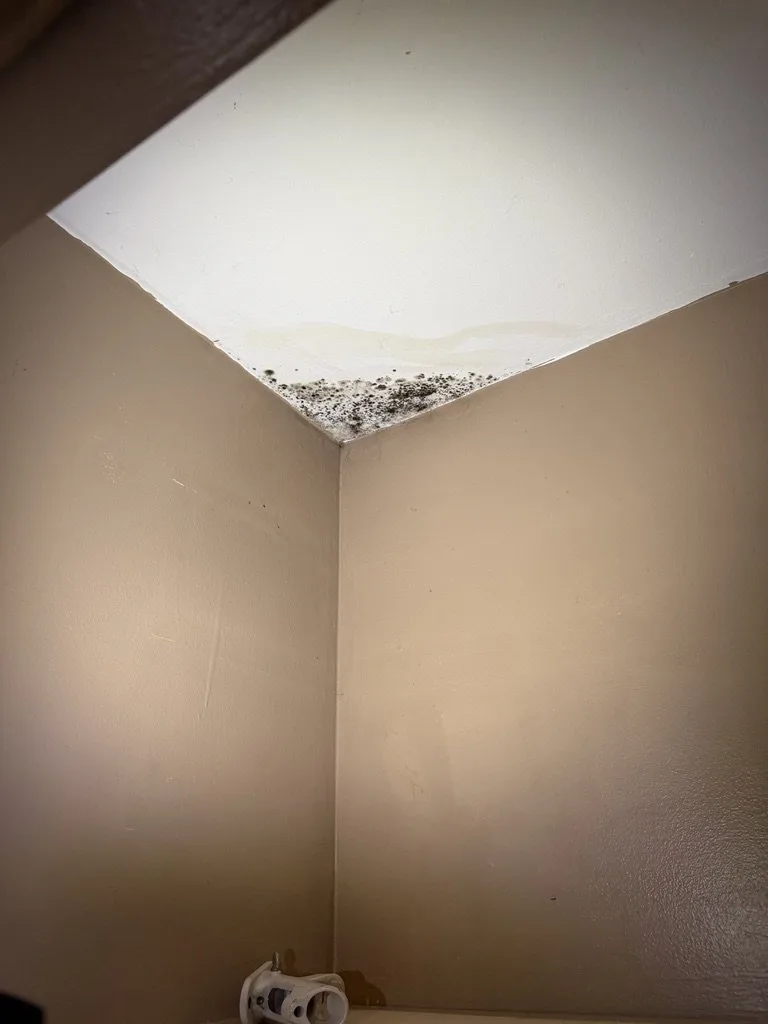
- Dark speckling at the wall to ceiling corner on an exterior wall, or along a sloped ceiling seam.
- Discoloration on the wall behind the headboard, dresser, or nightstand.
- Clothing, shoes, or leather goods in a closet that smell musty or feel damp.
- Peeling paint, blistered drywall, or a wavy baseboard on an exterior wall.
- Allergy or asthma symptoms that are worse in the morning and improve after leaving the room. This is a reason to investigate the room, not a diagnosis. Health questions go to a physician.
If any of those show up, turn the humidifier off first, then figure out what the moisture did. Growth on drywall spreads through the paper facing, which means what is visible on the surface is often smaller than what is behind it.
What an inspection actually finds in a humidifier case
Bedroom humidity cases are one of the cleaner problems to diagnose, because the moisture pattern is distinctive. There is no plumbing leak upstream and no water stain radiating out from a source. Instead the moisture tracks the cold surfaces.
A mold inspection for this scenario looks like:
- Conditions first. Temperature, relative humidity, and dew point recorded in the bedroom, at the exterior wall, in the closet, and outdoors, so the room can be compared against the rest of the house.
- Thermal survey. A FLIR scan maps the cold surfaces and shows where the wall assembly is losing heat. Thermal imaging finds temperature difference and moisture patterns, never mold itself. Our guide on what thermal imaging can and cannot detect covers that distinction in full.
- Moisture confirmation. Every cold area gets checked with a moisture meter. A cold spot without elevated moisture is an insulation gap, and it gets documented as exactly that.
- Cavity inspection where warranted. A borescope can look inside a wall or a knee wall through a small access point instead of opening a section of drywall.
- Air sampling. Air samples collected in the bedroom with a calibrated Buck BioAire sampler, alongside an outdoor control sample taken the same day at the same property, so indoor spore counts have something meaningful to be compared against.
- Laboratory analysis. Samples are analyzed by a certified third-party AIHA and NVLAP accredited laboratory.
- Report. Observations, instrument readings, and lab data documented, with recommendations kept separate from findings.
Spore Shield does not perform remediation. We test and document only, which means the finding on your bedroom wall is not connected to anyone's incentive to open it up. A frequent outcome of a humidifier investigation is a clear report plus a humidity setting change, and that is a legitimate result worth having in writing.
Areas we serve
Independent mold inspection and air quality testing across Metro Detroit and Southeast Michigan. See all service area locations, including:
- Oakland County: Royal Oak, West Bloomfield, Birmingham, Bloomfield Hills, Troy, Beverly Hills, Franklin, Huntington Woods, Berkley, Ferndale, Clawson, Southfield, Farmington Hills, Novi, Commerce Township, Wixom, Rochester Hills, Waterford, Milford, Auburn Hills
- Wayne County: Livonia, Northville, Plymouth, Canton, Dearborn, Grosse Pointe, Redford, Westland, Detroit
- Macomb County: Sterling Heights, Warren, Shelby Township, Macomb Township, Clinton Township, St. Clair Shores
- Washtenaw County: Ann Arbor, Ypsilanti, Saline, Dexter, Chelsea
Frequently asked questions
Can a humidifier cause mold in a bedroom?
What humidity should my bedroom be in a Michigan winter?
Do I need a dehumidifier if I use a humidifier?
Why do my bedroom windows have condensation in the morning?
Is it safe to sleep in a room with a humidifier running all night?
How often should I clean a bedroom humidifier?
Can mold grow behind a bed or dresser from humidity alone?
Should I test for mold or just lower the humidity?
Book an independent mold inspection
Thermal imaging, moisture meters, borescope inspection, and calibrated air sampling analyzed by a certified third-party AIHA and NVLAP accredited laboratory. Certified, insured, and testing only. Serving Royal Oak, West Bloomfield, and communities across Metro Detroit and Southeast Michigan.
Call (248) 955-2269 or contact us to schedule. Questions by email go to info@sporeshield.com.
Sources
Test Your Home
Today!
Trusted by Michigan families, Spore Shield delivers fast, accurate mold testing. Pick a time online in minutes.
Book Your Inspection