
Mold and Drywall: Why Wet Walls Grow Mold (And What It Looks Like)
Short answer: Drywall is one of the best mold food sources in your house. Its paper facing is cellulose — the exact organic material mold feeds on — and its gypsum core holds water like a sponge. Once drywall gets wet and stays wet, mold can begin growing within 24 to 48 hours, according to the U.S. EPA. Fix the water and mold stops. Ignore the water and the wall becomes a colony.
That relationship — water, then wet drywall, then mold — is the single most common story we document on Metro Detroit inspections. Below are three real photos from the field showing each stage of it.
Why drywall and mold go together
A wall assembly gives mold everything on its checklist:
That's why mold rarely grows on a clean pane of glass or a steel beam, but happily takes over a drywall corner. Water is the only variable you actually control. Every legitimate mold protocol — EPA, IICRC S520 — starts from the same principle: remove the moisture source first, because cleaning mold without fixing the water just resets the clock.
Not sure if what you're seeing is mold?
Snap a photo and get a free AI analysis in about 60 seconds — no appointment needed.
1. Signs of water-damaged drywall
Water damage almost always announces itself before mold does. Learn to read the wall.
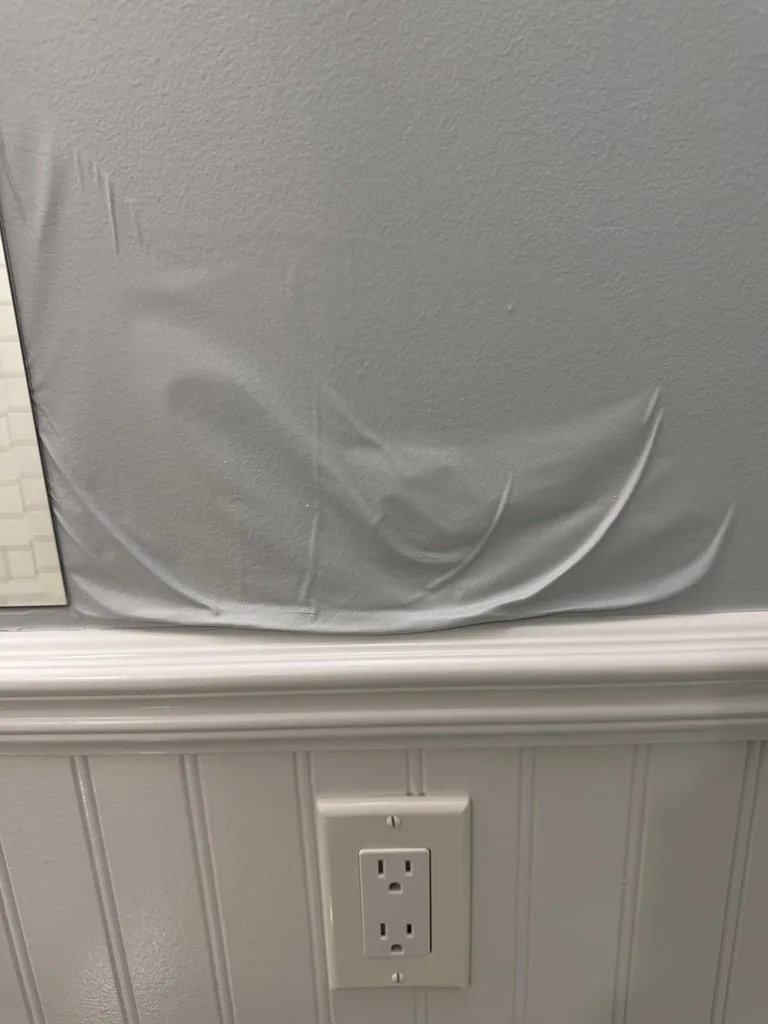
The wall in the photo above is telling you it got wet. The rippling and blistering happens when moisture gets between the paint film and the paper face, or when the paper facing itself swells and separates from the gypsum core. Drywall does not do that on its own. Something wet it.
Visual signs to look for
- Bubbling, blistering, or wrinkled paint — moisture behind the paint film
- Brown, tan, or yellow staining — mineral deposits left behind as water evaporates (a “tide line” shows where the water stopped)
- Sagging or bowing between studs — the gypsum has lost structural integrity
- Soft or spongy feel when you press it — the board is saturated or already deteriorating
- Seam and tape separation — paper tape lifting at joints or inside corners
- Nail pops and screw dimples cracking out — wood framing swelled and shrank behind the board
- Crumbling or chalky texture at the base of a wall — long-term wicking from a wet floor or foundation
- Musty odor with no visible cause — microbial VOCs escaping through the wall cavity
What causes it (in order of how often we find it)
- Plumbing supply or drain leaks inside the wall
- Roof leaks and ice dams tracking down the sheathing (a Michigan specialty)
- Foundation seepage and hydrostatic pressure in basements
- Window and door flashing failures
- Bathroom humidity with no working exhaust fan
- HVAC condensate lines and sweating supply ducts
- Appliance leaks — washers, dishwashers, refrigerator lines, water heaters
Rule of thumb: if the stain is on the ceiling or high on the wall, look up. If it's at the baseboard, look down and out. Water is only ever obeying gravity.
2. Mold growing directly on drywall
When wet drywall stays wet, growth shows on the surface — usually within days, not months.
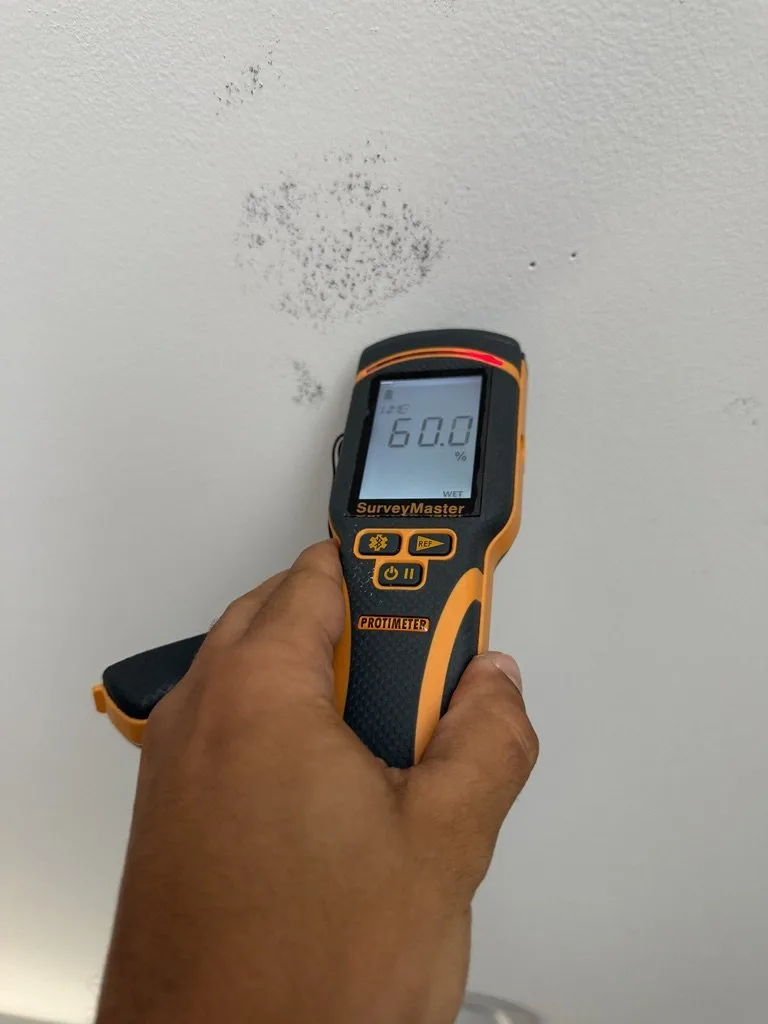
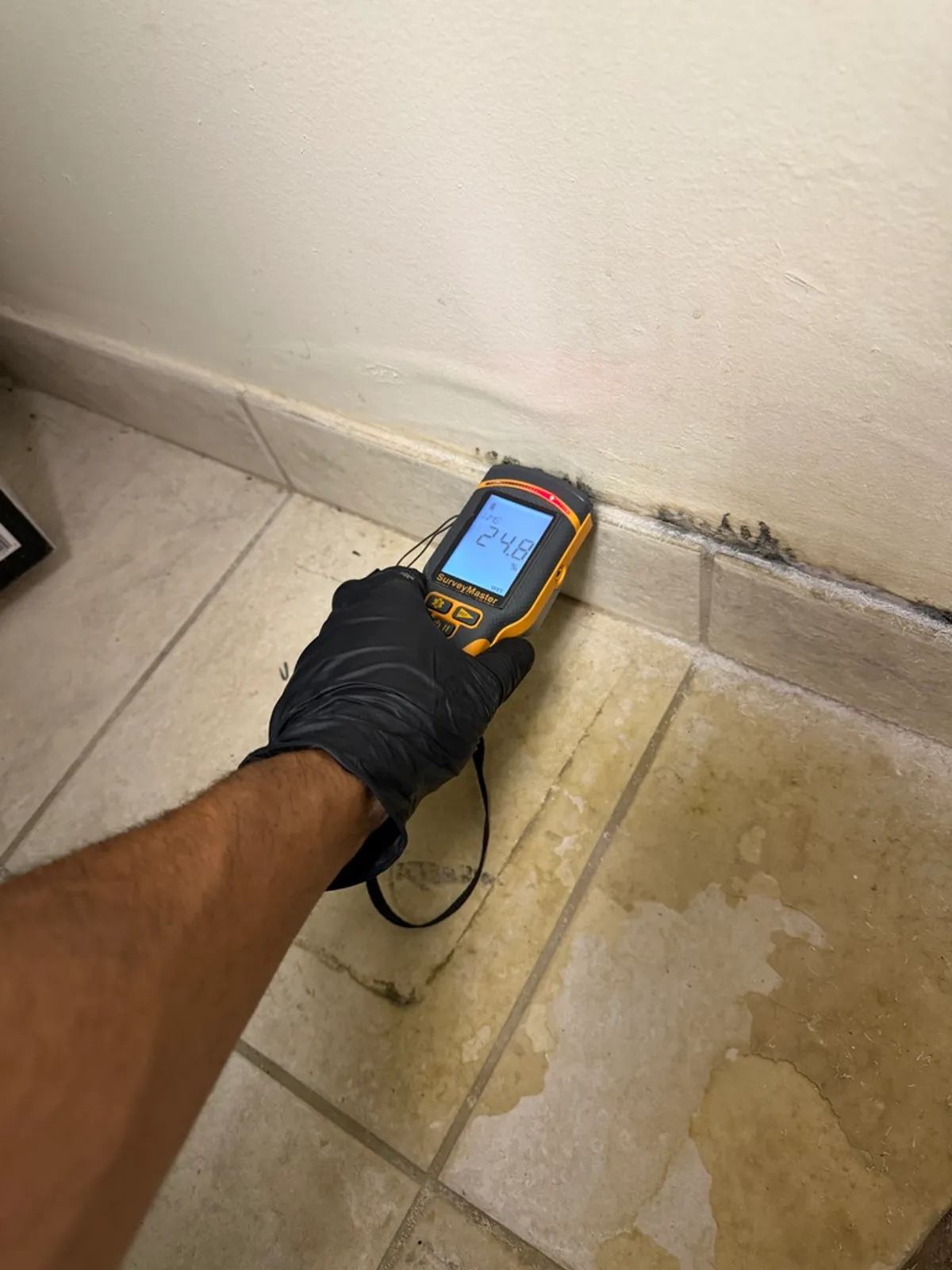
Visible growth plus a wet meter reading is a moisture problem, not a cleaning problem. The meter is the part homeowners skip. Anyone can see the spots. The reading is what tells you the wall is still wet — meaning the source is active and the mold will come back no matter how hard you scrub.
What mold on drywall looks like
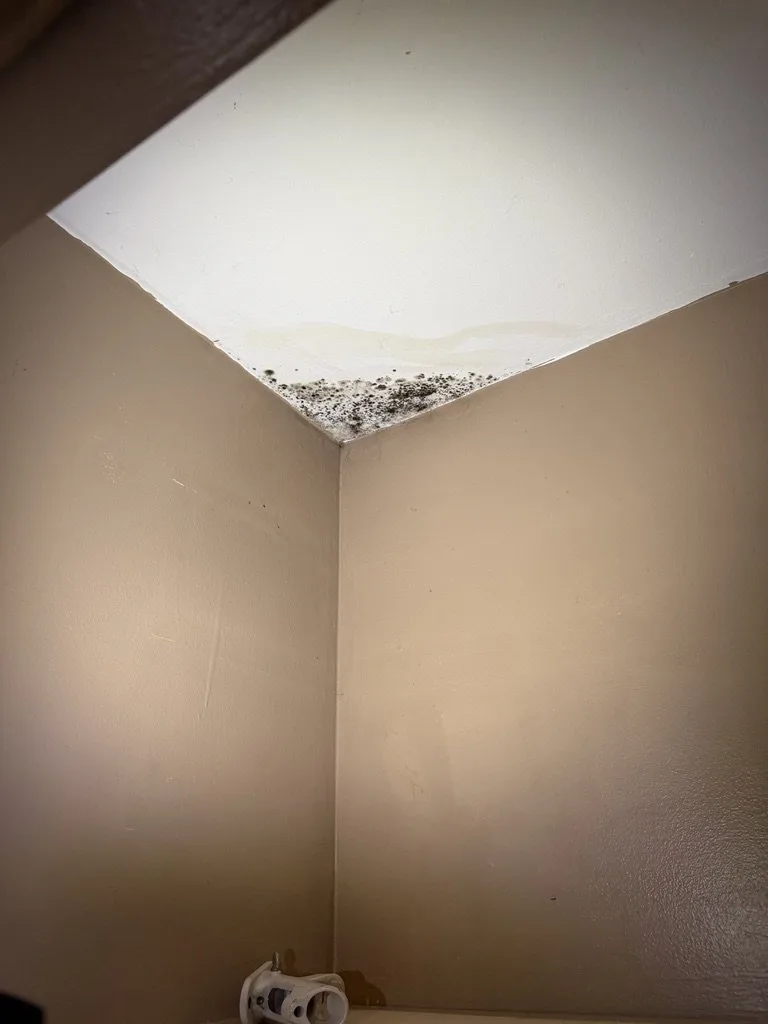
The ceiling corner above is the most common presentation we see on roof and ice-dam claims: the ceiling drywall shows the water path, and the corner — the coldest, least-ventilated spot in the room, where condensation adds to the problem — shows the growth. Unmeasured humidity from a bedroom humidifier can create the same condensation pattern without any leak at all.
Can moldy drywall be cleaned, or does it have to be replaced?
The EPA's guidance is direct: hard, non-porous surfaces can be cleaned; porous materials that have absorbed water and grown mold — including drywall and ceiling tiles — generally must be removed and replaced. (EPA: Mold Cleanup in Your Home)
Painting over mold, spraying bleach, or hitting it with a stain-blocking primer are the three most expensive “fixes” we see. They hide the evidence while the wall cavity keeps feeding the colony. Bleach in particular is mostly water — on a porous material, you kill the surface and donate moisture to the roots.
3. Mold behind drywall (the part nobody sees)
Hidden mold is the version that matters. The wall cavity is dark, unventilated, and full of paper-faced gypsum, wood framing, and dust. When a leak wets the back side of the board, growth starts on the cavity face — the side you can't inspect — and the room may look perfectly normal for months.
Signs of mold behind drywall
- Musty odor with no visible growth — the single strongest indicator
- A stain or bubble on the finished side with nothing spilled in front of it
- Unexplained allergy symptoms that improve when you leave the house
- Cold spots on an interior wall (moisture conducts heat differently — this is what thermal imaging picks up)
- Warped baseboards or trim pulling away from the wall
- A past leak that was “dried out” with fans and never verified with a meter
- Efflorescence (white crystalline residue) on an adjacent basement foundation wall
How an inspector actually finds it — without demolishing your wall
This is where a real mold inspection separates from a flashlight-and-a-guess:
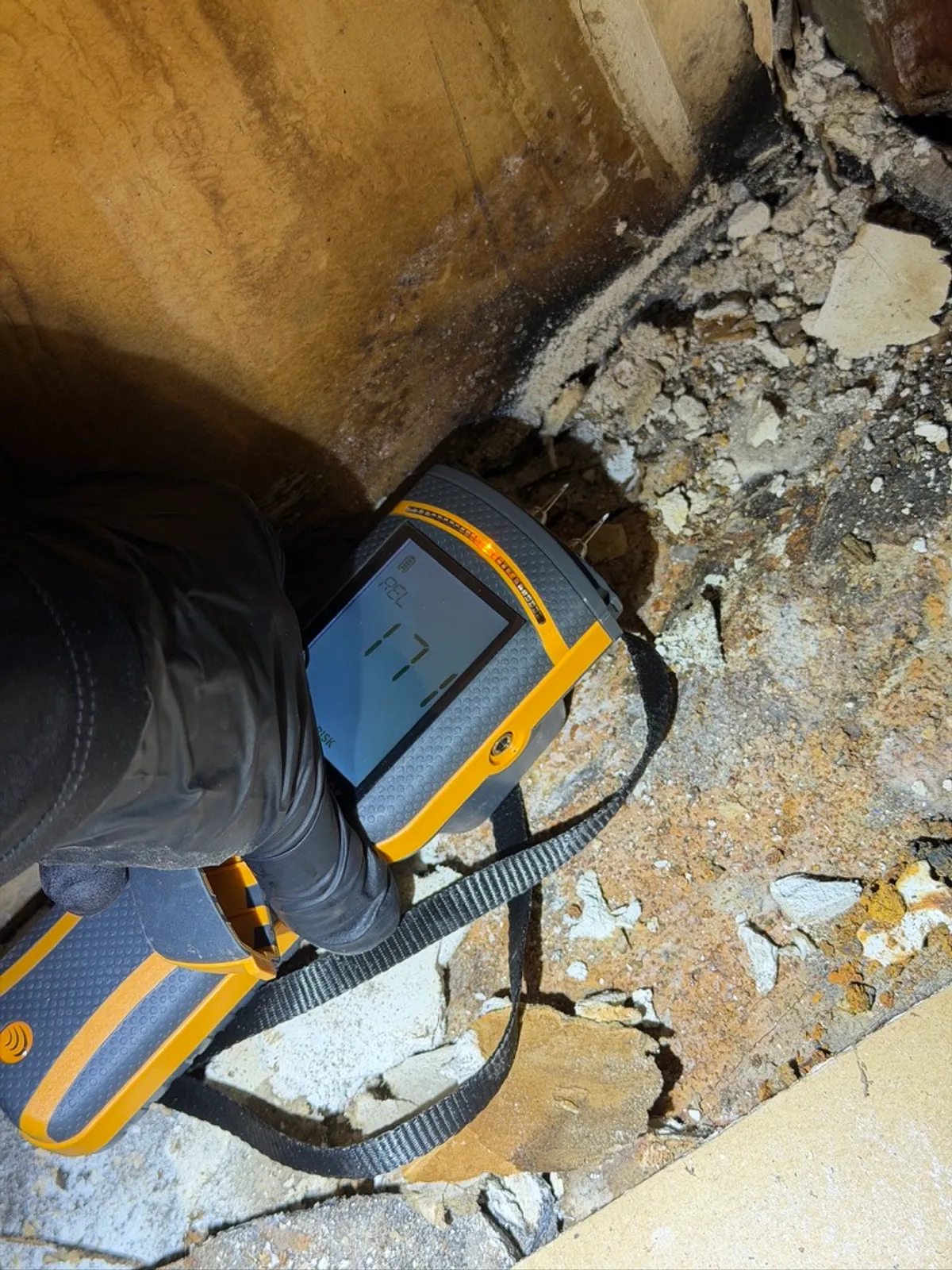
- Moisture mapping — a Protimeter is run across the suspect area in both search (non-invasive) and pin modes to find the wet zone and its boundaries. We compare every reading to a dry baseline of the same material in the same room.
- Thermal imaging — a FLIR camera reveals temperature anomalies where evaporative cooling from trapped moisture shows through the drywall.
- Borescope inspection — a small camera goes through a discreet hole (roughly the size of a dime) to see the cavity face of the drywall, the insulation, and the framing.
- Air sampling — spore-trap cassettes are collected indoors and compared against an outdoor control sample. Elevated indoor counts of indicator genera (Penicillium/Aspergillus, Stachybotrys, Chaetomium) relative to outdoors point to an interior amplification source — that's a lab-confirmed way to say “something is growing in here” without knocking out a wall.
- Lab confirmation — samples go to an AIHA-accredited laboratory. The report is the document that holds up with insurers, buyers, and remediation contractors.
A visual-only inspection can miss a fully colonized wall cavity. Moisture readings plus a lab result is how you turn a suspicion into a defensible finding. If you are weighing which sample type applies, our guide to air vs. surface mold samples breaks it down.
Surface mold vs. mold behind drywall
Why Michigan homes are especially prone to this
Metro Detroit puts drywall through a brutal cycle:
- Ice dams back water up under shingles in January and February, and it shows up as a stained ceiling corner in March.
- Freeze-thaw cycles crack foundation walls, and spring thaw pushes water through them into finished basements.
- Humid summers with air-conditioned interiors create condensation on cool wall surfaces and inside cavities.
- Finished basements — extremely common here — put paper-faced drywall directly against below-grade masonry, sometimes with no capillary break.
A wall can be wet in February, dry-looking by June, and fully colonized behind the paint the entire time.
What to do if you see any of this
- Stop the water first. Nothing else matters until the source is off.
- Don't paint, prime, or bleach it. You'll destroy the evidence and keep the food source.
- Don't tear it open yourself. Disturbing colonized drywall aerosolizes spores through the house. Cutting into a wall without containment is how a one-room problem becomes a whole-house problem.
- Get it documented before anyone remediates it. An independent inspection with moisture data, thermal imaging, and lab-confirmed air samples establishes scope — before a contractor with a demo crew tells you what your scope is.
- Verify the fix. Post-remediation clearance testing is the only way to prove the work actually worked.
Frequently Asked Questions
The questions homeowners ask most about mold, drywall, and water damage.
Does wet drywall always grow mold?
Can I just paint over mold on drywall?
Does drywall have to be replaced after mold?
How can I tell if mold is growing behind my drywall?
Is black mold on drywall dangerous?
How long does it take mold to grow on wet drywall?
Do I need a mold test if I can already see the mold?
Get the wall looked at properly
Spore Shield is an independent mold inspection and testing company serving West Bloomfield and Metro Detroit. We don't do remediation — which means we have no financial reason to find more mold than you actually have. Every inspection includes moisture mapping with a Protimeter, thermal imaging, and air sampling analyzed by an AIHA-accredited laboratory, delivered as a documented report you can hand to a buyer, an adjuster, or a contractor.
Call (248) 955-2269 or view our pricing and packages.
Test Your Home
Today!
Trusted by Michigan families, Spore Shield delivers fast, accurate mold testing. Pick a time online in minutes.
Book Your Inspection