

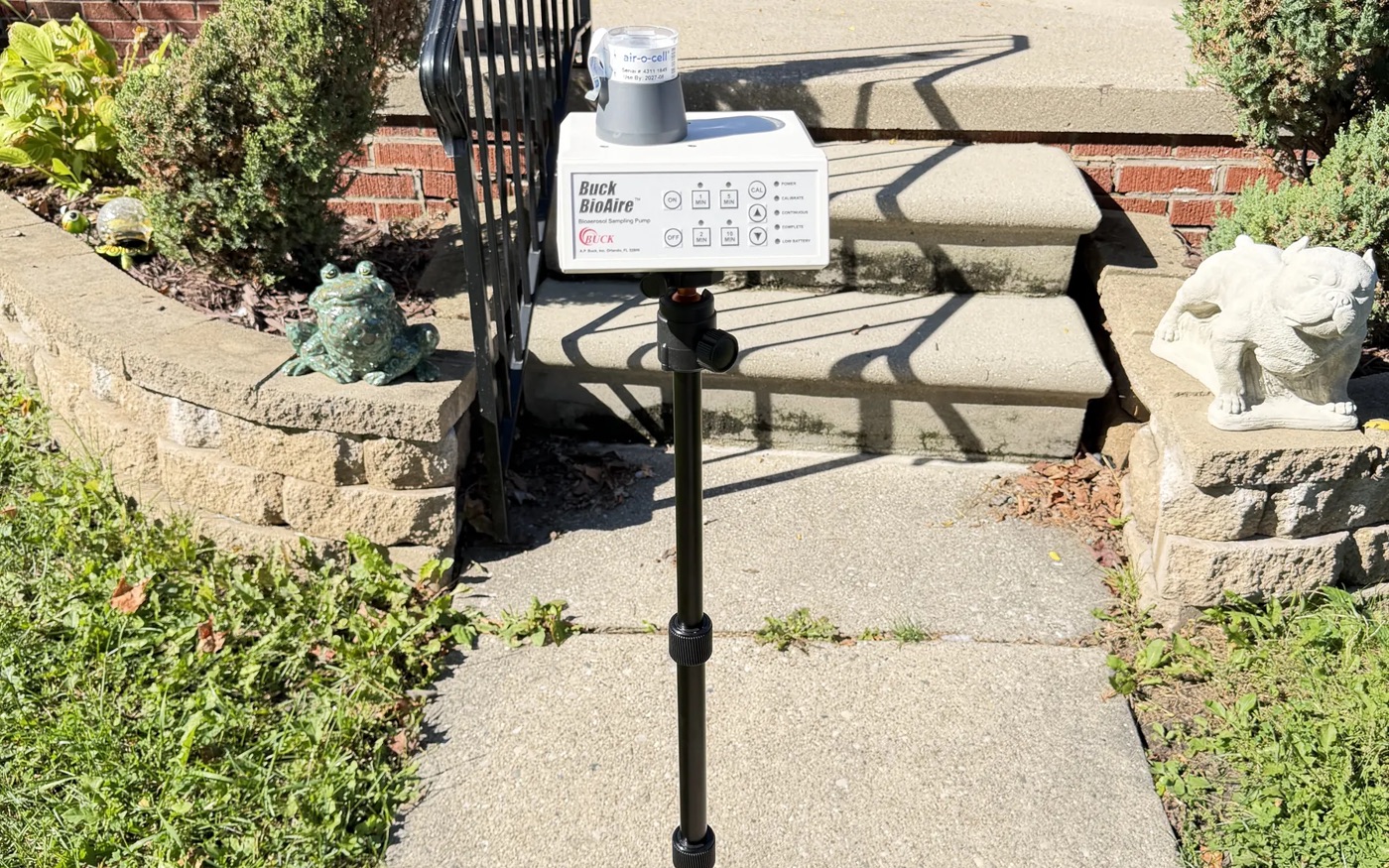
Short answer: mold spores are a normal part of outdoor air, and there is no state or federal limit that says how many is too many indoors. So an indoor spore count only means something next to what the outdoor air at your property was doing that same day. Without that comparison, you have a number and no honest way to say what it means.
We get asked about this all the time, usually when someone sees the outdoor sample on the invoice. It's a fair question. You called about the inside of your house. Why pay to test your yard?
Your indoor air starts as outdoor air
Spores come inside through open doors, windows, and ventilation, and on shoes, clothes, and pets. So healthy indoor air generally looks like a quieter version of the air outside: similar types of spores, in lower numbers. Comparing the two is generally accepted assessment practice, and it's what the test is built around. When that pattern flips, a source inside the building becomes a real possibility.
Outdoor air doesn't hold still, either. Spore levels move with the season, humidity, rain, and wind. That's why the comparison has to come from your property on the day of the test. Last week's reading or a seasonal average can't stand in for it.
Want numbers you can actually read?
Book an inspection and get your indoor air compared against same-day outdoor air.
Same indoor number, opposite meaning
Here's how that plays out. These numbers are made up to show the idea. They aren't from a real inspection.
The indoor result is identical. Without the outdoor sample, those two houses get the same answer. So the control works in both directions. It can keep you from panicking over a number that's normal for the day, and it can catch a number that only looks small.
The total isn't the whole story
The lab breaks results down by spore type, and each type gets compared to its outdoor number. This is where the outdoor sample really earns its spot. Again, these numbers are made up for illustration.
Look only at the totals and you'd relax. Indoor is less than a quarter of outdoor. But Penicillium/Aspergillus is about seven times higher inside than outside, while everything else is lower. A pattern like that can point to a source indoors, and you can't see it without the outdoor column.
It doesn't tell you where the source is or how much growth there is. That's what the moisture readings and visual inspection are for.
What the outdoor sample can't tell you
- Whether your home is safe. There are no state or federal exposure limits for airborne mold spores, so no air test can give you a pass or fail on safety. Health questions belong with your doctor.
- Whether a wall is clean. An air sample captures the air during that sample. Growth sealed inside a wall cavity may not show up, so a low indoor result doesn't clear the materials around it.
- What changed between visits. Air results from two different days each have their own outdoor conditions, so they often can't be compared number for number.
Can I skip it to save money?
Not with indoor air testing. Spore Shield requires one same-day outdoor control whenever we collect indoor air samples, and it's billed as its own sample because it's the same work: same pump, same type of cassette, same analysis at a certified third-party AIHA/NVLAP-accredited lab. That makes the smallest air test two samples, one inside and one outside. Current rates are on the pricing page.
You still stay in control. We show you the recommended sample count and fee on site before anything is collected, and you can decline sampling. We just won't sell you indoor air numbers we couldn't interpret. If you only need to identify something growing on a specific surface, a surface sample doesn't need an outdoor control.
One question to ask any inspector
If an inspector or a home test kit gives you indoor air results, ask what they're being compared to. If the answer isn't same-day outdoor air, you can't read much into the number. Want to see what the comparison looks like on paper? Our redacted sample report shows lab results read against the outdoor control.
Frequently Asked Questions
Why do I have to pay for an outdoor sample?
Can another room in the house be the baseline instead?
Can you reuse an outdoor sample from another day?
Do surface samples need an outdoor sample?
Does the outdoor sample still work in a Michigan winter?
If my indoor count is lower than outdoors, does that mean I have no mold?
Is there a safe number of mold spores?
Need your air tested in Metro Detroit?
Spore Shield provides independent air testing and mold inspections across Wayne, Oakland, and Macomb counties. We only test, so you get the numbers and what they mean, with no remediation job attached.
Call (248) 955-2269 or book an inspection online.
Test Your Home
Today!
Trusted by Michigan families, Spore Shield delivers fast, accurate mold testing. Pick a time online in minutes.
Book Your Inspection